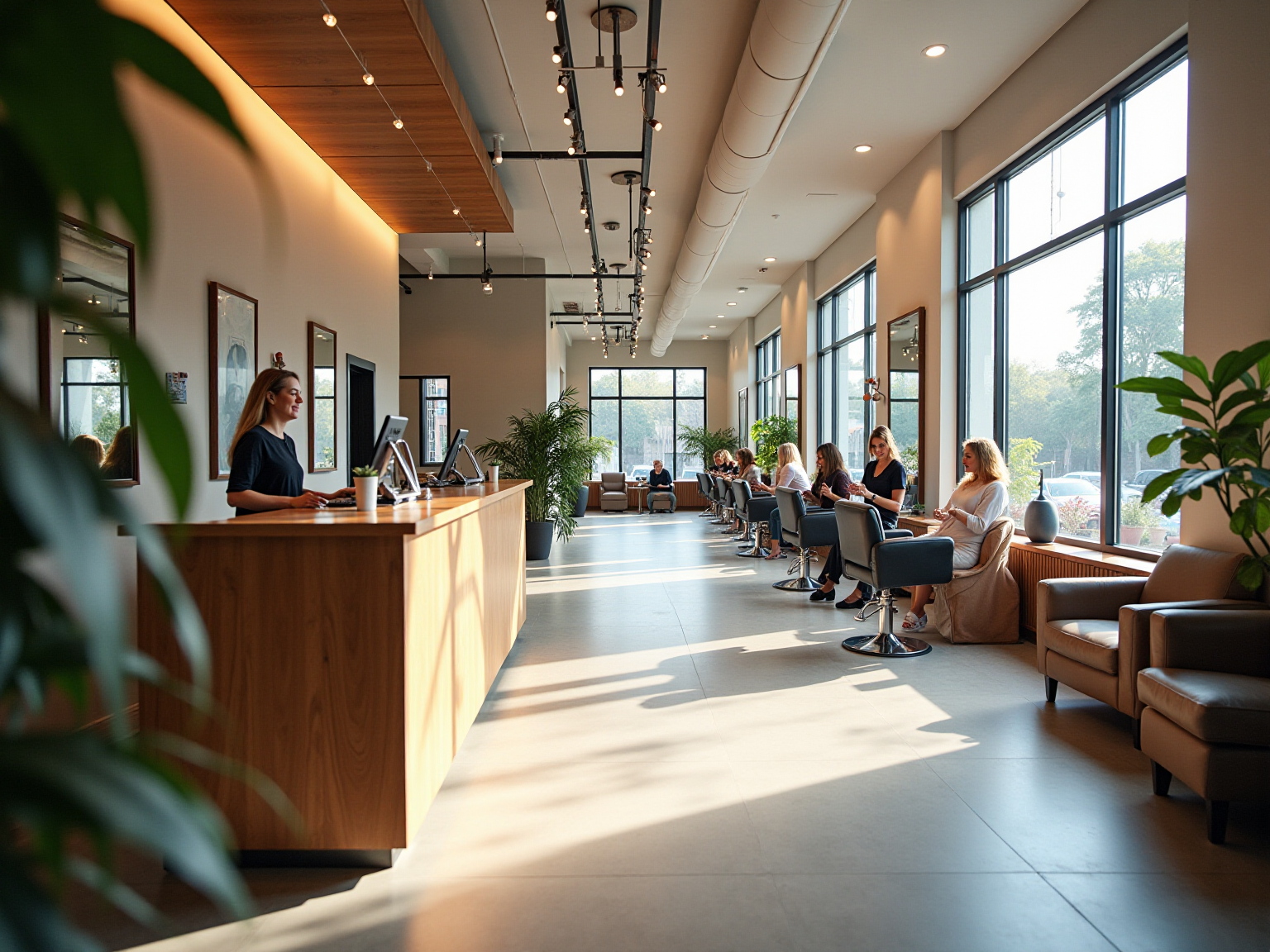
Best Practices for Salon Layout Design: Creating Spaces That Enhance Client Experience


Design Rules That Make a Salon Feel Premium (and Run Faster)
A salon layout isn’t decor. It’s a system that controls traffic flow, service speed, staff stress, and whether clients feel calm or crowded. A “beautiful” space can still underperform if clients bump into each other, stations are too tight, or checkout blocks the entrance.
This guide gives practical layout rules you can apply whether you’re opening a full salon, building a studio, or setting up inside a suite.
Start With the Client Journey (Not the Furniture)
Before choosing chairs or mirrors, map the path a client takes:
Arrival → Check-in → Waiting (if needed) → Service → Sink / processing (optional) → Checkout → Rebook → Exit
Your layout should make that path feel effortless:
- No bottlenecks at the entrance
- No awkward walking through active stations
- No checkout line cutting through the service zone
- Clear “where do I go?” moments without signage overload
Choose the Right Layout Type for Your Business Model
Different models need different priorities.
Open Concept
Best for: social vibe, high visibility, retail-driven salons.
Watch-outs: noise, privacy, congestion.
Use it if you want energy and teamwork, but protect clients from feeling “on display” by adding partial dividers, plants, or zoning by flooring/lighting.
Zoned Layout (Hair / Nails / Skin / Brows)
Best for: multi-service salons, efficiency, less distraction.
Watch-outs: duplicated storage and supply needs.
Zoning reduces chaos and helps each service area run like its own mini-studio.
Private / Semi-Private Studios
Best for: premium appointments, privacy-first services, higher-ticket positioning.
Watch-outs: ventilation, sound isolation, storage, smaller retail opportunities.
Studios feel high-end when you control lighting, sound, and clutter.
Circular / One-Way Flow
Best for: narrow spaces, high traffic, busy salons.
Watch-outs: too much “hallway” space if planned poorly.
A smooth loop prevents clients from crossing paths and keeps movement intuitive.
Core Floor Plan Zones Every Salon Needs
You don’t need a big salon. You need the right zones.
Reception That Doesn’t Block the Entrance
Reception should be visible from the door, but not physically blocking entry.
Common mistake: placing a front desk directly in the main corridor so every client has to squeeze past it.
Practical rules:
- Keep the first 6–10 feet of the entrance visually open
- Make the “first stop” obvious (desk, host stand, or self check-in area)
- Avoid putting retail shelves where clients line up
Waiting Area That Feels Intentional
A waiting area is not “extra chairs.” It’s a calm buffer that protects the service zone.
Practical rules:
- Don’t point waiting seats directly at active stations (clients don’t want to watch strangers)
- Keep walkways clear for strollers, wheelchairs, and big bags
- Add charging, water, hooks, and small surface space
If you run appointment-only and stay on time, the waiting area can be smaller—but it should still feel like a designed part of the brand.
Styling Stations That Don’t Feel Cramped
Stations define the entire experience. If clients feel crowded, the salon feels cheap.
Practical rules:
- Leave enough space behind each chair for the stylist to work comfortably without bumping others
- Prevent “chair overlap” where two clients’ personal space collides
- Ensure electrical access without extension cords crossing walkways
- Build a “clean path” for tools and towels so you don’t carry items through the client zone
Shampoo / Processing Area That Stays Quiet
The shampoo zone is where clients relax. It should feel separate from the loudest part of the salon.
Practical rules:
- Reduce line-of-sight from the front door into shampoo bowls
- Create towel storage right next to bowls (not across the room)
- Plan ventilation if you run color frequently
- Keep wet zones away from retail and checkout
Storage That Prevents Visual Clutter
Clutter destroys the premium feel faster than any design choice.
Practical rules:
- Plan storage before decor (backbar, closed cabinets, hidden hampers)
- Place supplies where they’re used, not in a “single storage room” that forces staff to walk constantly
- Separate clean vs used tools and towels (visually and physically)
Accessibility and Safety (Non-Negotiable)
Even small salons should plan for accessibility and safety from day one.
Include:
- Wide, unobstructed pathways (especially near entrance and restrooms)
- No cords across walkways
- Non-slip flooring in wet zones
- Clear emergency exits and access paths
- Space that allows a wheelchair user to navigate without moving furniture
If you’re unsure, plan more clearance than you think you need. Tight layouts look profitable on paper and feel stressful in real life.
Lighting, Sound, and Smell: The “Invisible” Layout
Clients judge your space emotionally before they judge the service.
Lighting
Use layered lighting:
- Bright task lighting at stations (accuracy)
- Softer ambient lighting in waiting and retail (comfort)
- No harsh overhead lighting that makes the salon feel clinical
Sound
Open layouts create echo and noise fatigue.
Fix it with:
- Soft materials (rugs, acoustic panels, curtains in select areas)
- Zoning (keep blow-dry zone away from quiet services)
Aroma / Ventilation
If you do nails, color, lashes, or chemical services, ventilation affects comfort and safety.
Plan airflow intentionally—don’t rely on “it will be fine.”
Mistakes That Kill Client Experience
These are the most common layout errors that quietly reduce repeat bookings:
- Entrance bottleneck (door → desk → crowd)
- Checkout inside the service lane
- Stations too close together (clients feel exposed)
- No dedicated storage (clutter everywhere)
- Wet zone crossing the main walkway
- Waiting area facing active services (awkward)
- Poor lighting at stations (service quality suffers)
- Forgetting staff workflow (stylists walk too much)
Quick Layout Checklist Before You Sign a Lease or Renovate
Walk the space and answer:
- Can a client enter, check in, and sit without crossing active work areas?
- Can staff move tools/towels without walking through client traffic?
- Is there a clear wet zone that doesn’t intersect retail or checkout?
- Is storage built into every zone where supplies are used?
- Can two clients pass each other comfortably in the main walkway?
- Does the salon feel calm when you imagine it at peak hours?
If you can’t confidently say yes, redesign before you buy furniture.
Layout Choices That Increase Revenue (Without “Selling More”)
A better floor plan increases revenue because it reduces friction:
- Faster turnaround without rushing
- Better on-time performance
- Less staff fatigue
- Higher perceived value (pricing power)
- More rebooking because the experience feels smooth
Premium experience is often a layout decision, not a marketing decision.
Final Thoughts
Salon layout design is an operational advantage. The best layouts feel effortless for clients and efficient for staff. If you design for flow, storage, and comfort first, the aesthetics become easier—and the business runs better.

Related Articles



Download our mobile apps
.webp)